 Centre for Inclusive Trade Policy home page
Blog post
Mapping UK trade policy: A systematic evidence-based foundation
Published 3 February 2026
In late 2025, we published a comprehensive analysis of the UK’s trade policy landscape: UK Trade Policy: An Independent Review. We encourage interested readers to look at the full report for more detail. Each chapter, listed below, can be read independently, with both an executive summary and key recommendations provided.
- Ch.1: UK trade and economic performance
- Ch.2: What do we know about UK trade policy
- Ch.3: Domestic dimensions of UK trade policy
- Ch.4: International dimensions of UK trade policy
- Ch.5: Trade and economic security
- Ch.6: Trade and the digital transformation
- Ch.7: Trade and sustainability
- Ch.8: Trade, employment and gender
In this series of blogs, we summarise each chapter. The first blog, ‘Trade, productivity, and the UK economy: What the data tells us’, provided an overview of the trends that have shaped the UK’s international trade profile, along with the context within which trade policy must be viewed. This second blog discusses in detail the methods, approaches and motivations that shaped our assessment of UK Trade Policy.
As we saw in the first blog, modern-day trade policy is cross-cutting, often intersecting with other areas of policy, and has to be made in an increasingly adaptive economic and social environment. While the recently published WTO’s trade policy review of the UK is extremely useful, comprehensive and informative, it faces inevitable structural limitations in ensuring its reviews serve as a template for all of its 166 members, and in the lack of evaluation, assessment and recommendations. In this context, our review takes a complementary approach aimed at addressing such constraints. We do so, in part, by providing a methodological approach to identify what the UK Government says it aims to do on trade, and how that actually maps onto the words and actions recorded in official strategies and legal texts.
For policymakers, trade professionals, and engaged citizens alike, an approach of this nature reveals not only the intentions behind UK trade policy but also the implicit priorities and omissions that influence real-world outcomes.
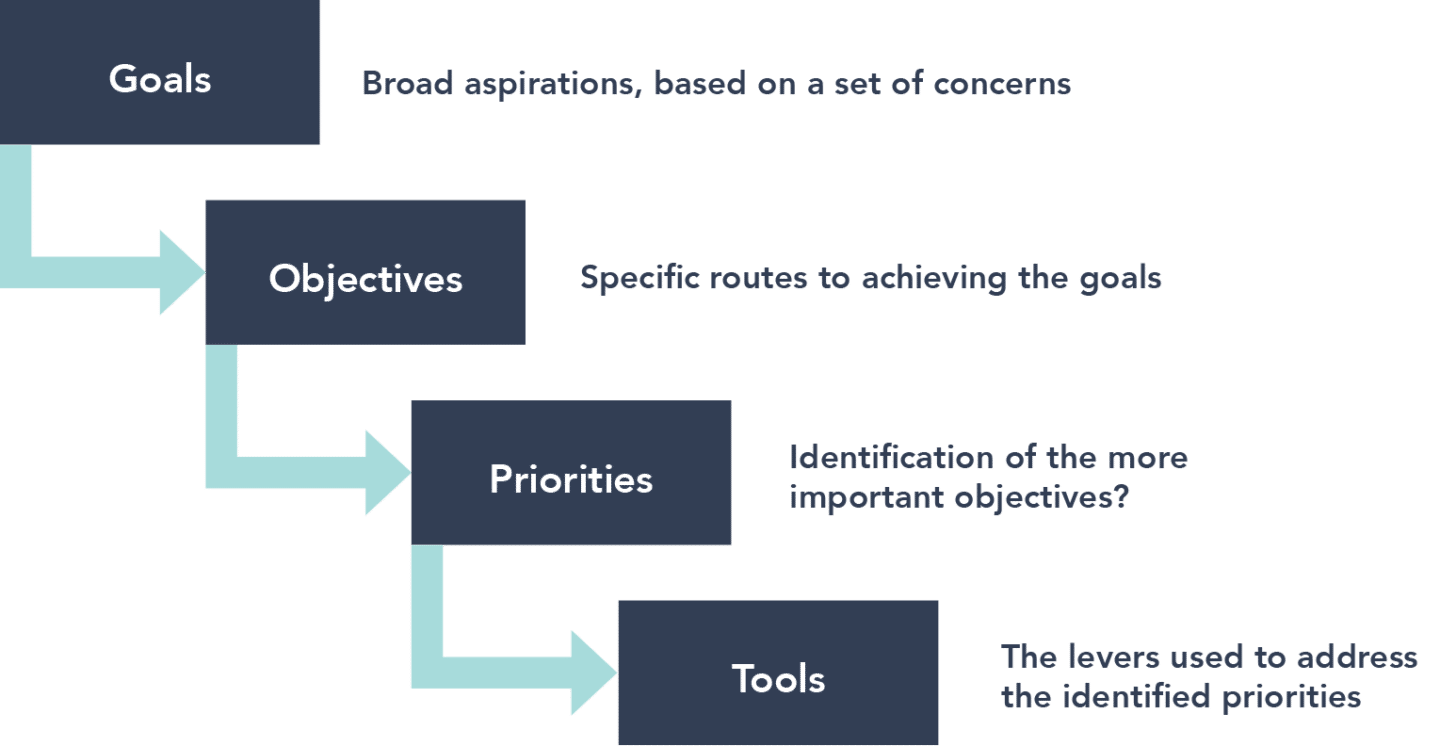
To identify the main elements of UK trade policy, it is useful to conceptually distinguish between goals, objectives, priorities and policy tools.
Figure 1: Organisation of goals, objectives and priorities
Our approach
To understand the goals, objectives, priorities and their evolution, it is important to consider the instruments of trade policy, and also look beyond the relevant legal frameworks and the policies being implemented throughout a given time period. For our evaluation, we study the development of UK trade policy between 2019-2024. In the UK, trade policy is rarely codified in one place. Responsibilities span multiple departments, legislative instruments, and over the years, governments have published strategies that intersect with trade in differing capacities. The publication of the Government’s industrial and trade strategies in 2025 was an important element that helped indicate and identify how the objectives and tools of trade policy may have evolved or shifted under the new government.
To identify the goals and objectives, and within these the priorities and tools, we undertook a detailed textual analysis of the most relevant government documents, which relate to international trade (our ‘trade corpus’) and which also formed part of the previous Conservative Government’s approach. We then discuss the evolution of trade policy since the election of the Labour Government in July 2024. Beyond documentation, we also draw on experts, and public engagement — including a public call for evidence, roundtables and a Citizens’ Jury conducted specifically for this review.
We use two complementary techniques: close textual analysis and natural language processing powered by machine learning approaches. These methods enable us to examine the presence of certain words or concepts mentioned within textual data, which in turn can help identify the focus and intentions of the government/ in the trade corpus.
First, we use corpus management software to identify a core set of key active verbs (‘increase’, ‘promote’, ‘reduce’ etc) which appear in our trade corpus relative to a reference corpus, and the context in which they appear. Identifying the active verbs and what they apply to enables identification of the stated objectives.
In the second stage, we use topic modelling1 to identify the semantic patterns and meanings in the texts that appear in the context of the active verbs to extract the key objectives.
In the third stage (as a complementary method), we employ detailed textual analysis. This entails a close manual reading of each document in the trade corpus, and, based on the results from the topic modelling and our expertise/judgement, we identify the objectives and the policy tools. By ‘trade-related’ we mean both explicit trade objectives (e.g. ‘increase exports’, ‘sign FTAs’), as well as objectives which are likely to have a direct or indirect impact on trade, even if trade is not explicitly mentioned. Examples of this might include ‘investment’ or ‘infrastructure’. In contrast, if there is an objective, for example, to ‘build more primary schools,’ we would not include this. We use the same method to identify the different policy tools the Government has employed in a trade context.
Using our expert judgement, we then group each of these objectives into categories or goals. The trade corpus is also useful in pointing out the Government’s differential focus across sectors.
What do the results reveal?
1. From the analysis, economic growth is the dominant goal. Growth is then linked to objectives such as support for businesses, competitiveness, innovation, and investment. The analysis also shows that other major public policy goals — such as environmental sustainability, economic security, and social inclusion — appear less consistently or less prominently in official trade texts. This contrasts with public opinion data and with the outcomes from our stakeholder consultations. This can be seen in the two figures below, where in the first we give the key priorities which emerge from the trade corpus, and in the latter we give the results of a Citizens’ Jury, where we asked the participants to rate the level of priority the UK Government should give to a number of different policy outcomes.
2. The figure below brings into discussion the main policy tools/instruments that have been mentioned across the trade corpus. The set of instruments which appear as most significant are trade-related instruments. This highlights the importance of trade policy to achieve the goal of economic growth as identified earlier. The trade policy instruments in this category range from trade agreements (which could be Free Trade Agreements or mini deals), trade remedies, reducing trade barriers, tariffs, import and export controls, to border barriers.
3. The most frequent sector that emerges is ‘critical minerals’, which appears in seven of the documents. This is followed by clean energy which appears in six of the documents, and then digital and automotive, each of which appears in five of the documents.
Conclusion
On the one hand, we sought to develop an approach that is transparent and replicable across countries, time periods, and policy contexts. On the other hand, we deliberately allowed room for nuance, expert judgement, and multidisciplinary perspectives. This balance is essential because trade objectives are not singular or confined to trade agreements alone; they are diverse, cross-cutting, and often embedded in broader economic, social, and regulatory frameworks.
As a result, trade objectives are pursued through a wide array of policy tools and institutional channels that conventional trade policy reviews tend to overlook. Enriching trade policy reviews to reflect this complexity is therefore necessary if they are to capture how trade policy actually operates in practice, identify government priorities accurately, and have an opportunity to assess coherence across policy domains.
Footnotes
- an unsupervised learning method in natural language processing that helps identify latent topics or themes from the unstructured textual data
Author Profile
