 Centre for Inclusive Trade Policy home page
Blog post
One year on: has Trump killed world trade? Not yet!
Published 2 February 2026
This article first appeared in the Royal Economic Society's January 2026 newsletter.
We can’t say we weren’t warned! Donald Trump’s first term as US president was marked by new duties on many US imports, one-sided renegotiation of trade agreements, a mini trade war with China and hostility towards the World Trade Organization.
Trump’s campaign for a second term featured complaints about being “ripped off” by foreigners, promises to reshore manufacturing and paeans to tariffs. As president, his international trade policy has been unprecedentedly frenetic, aggressive and incoherent.
Starting on February 1 2025, he announced stiff tariffs on China, Canada and Mexico ostensibly to halt the inflow of fentanyl and immigrants, shortly followed by tariffs on steel, aluminium, cars and car parts on national security grounds. Base-tariffs on China escalated to 145 per cent in April and subsequently several other “national security” tariffs were introduced.
Trump frequently declared the US balance of trade deficit a national emergency, and on April 2, “Liberation Day”, he invoked the International Emergency Economic Powers Act (IEEPA) to announce “reciprocal tariffs” of 10 per cent on imports of most goods from all countries, and above 10 per cent for 60 countries.
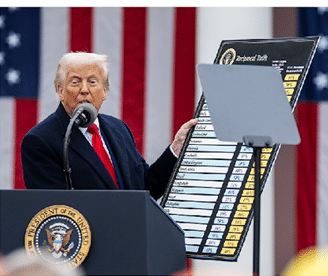
The White House, Public domain, via Wikimedia Commons
Many of the announcements were quickly clarified, modified or revoked, mostly in response to retaliation, lobbying or, recently, “affordability” concerns. Most notably, after protests and turmoil in bond and equities markets, Trump “paused” the “Liberation Day” tariffs for 90 days on the day they came into effect. He announced that partners could avoid these tariffs if they negotiated “satisfactory” agreements with the US.
The resulting agreements — seventeen so far — are not legally binding and vary greatly in terms of both the final US tariff and the trade preferences partners offered in return. Some also include promises of huge stateside investments, commercial concessions to US firms and other sweeteners. (The agreement with Switzerland was closed in November only after Swiss business gifted Trump a gold bar and a Rolex watch.) Others imposed conditions on partners over their trade policies with “other countries” — i.e. China.
With China there were temporary agreements in May and November, interspersed with threats, retractions and extensions of non-tariff measures, notably export restrictions. Having demonstrated to China the huge leverage that its monopoly of rare earths has created, Trump is now quiescent, anxious to keep the current agreement alive until April.
The constant change and the political and sometimes quixotic nature of some of Trump’s tariffs have greatly increased trade uncertainty both for the US and others — see Figure 1.
Figure 1: trade policy uncertainty spiked in 2025
Source : See Appendix /asset/The-dataset.pdf
Trump’s interventions refer to trade in goods; his political focus is manufacturing and agriculture. Moreover, regulating services trade is complex and time-consuming, not Trump fortes, and generally raises no revenue.
In terms of effects, the strongest are on American imports. Figure 2 shows US monthly imports of goods disaggregated over five sources — two “serious” targets (those which received most of Trump’s attention), China, and Canada plus Mexico; two “minor” targets, and a residual. Total imports boomed in January and March 2025 in anticipation of tariffs and then settled at levels below those of mid-2024. Possible causes of the latter include import suppression, the decline in the dollar in 2025 or the unwinding of the previous front-loading.
Figure 2: US imports of goods, January 2023 – September 2025, $ billion
Source: Authors from US Census Bureau data
The decline in imports from China over 2025 is obvious, as is the growth in those from ASEAN and the rest of the world (ROW). Trump has frequently threatened imports from Canada and Mexico, but they have not declined (yet): Canada retaliated (although often then retreated) while Mexico mostly used charm. But, more importantly, their pre-existing trade agreement with the US provided some defence.
A global view of 2025 comes from Table 1 which reports the growth in trade between January and September 2025 (the latest data available) and January and September 2024. The data is provisional and incomplete — see Appendix — but still informative.
Table 1: Growth in world trade flows in US dollars, January-September 2024 to January-September 2025 (%)
| exporter | importer | ||||||
|---|---|---|---|---|---|---|---|
| USA | CHINA | CAN+MEX | ASEAN | EU | ROW | Total | |
| USA | -21.9 | -2.7 | -0.3 | 11.9 | 13.3 | 4.5 | |
| CHINA | -24.2 | 1.0 | 20.9 | 13.0 | 10.2 | 3.5 | |
| CAN+MEX | 0.7 | 3.4 | 3.5 | 19.1 | 13.2 | 5.6 | 2.2 |
| ASEAN | 27.6 | 4.9 | 20.2 | 6.0 | 16.5 | 10.3 | 15.3 |
| EU | 9.1 | -7.1 | -2.3 | 1.6 | 5.4 | 5.1 | 5.1 |
| ROW | 19.5 | 5.8 | 4.3 | 0.8 | 2.6 | 0.5 | 4.8 |
| Total | 7.2 | 0.9 | 0.3 | 4.3 | 6.1 | 5.5 | 5.3 |
The most striking feature is the dichotomy between the three principal protagonists — the US, China, and Canada plus Mexico — and the other regions. Trade within the first group was static or worse — Mexico and Canada traded normally, but both curtailed imports from China for fear of angering Trump. Other than the EU’s dismal extra-EU export growth, trade between the other groups was fairly buoyant. This may reflect trade diversion, but also a valuation effect of the declining dollar. The two largest growth rates pertain to ASEAN — imports from China (although imperfectly measured) and exports to the US, arguably suggesting some re-routing of Chinese exports.
The Trump trade shock is unprecedented in postwar history, in terms of both the level of protection — an average US tariff of 14 to 17 per cent in November 2025 — and its frequent and unpredictable changes. Nine months of data is insufficient for any reliable assessment, but there are several reasons for fearing that 2026 will be worse.
The tariffs will only minimally contribute to their ostensible goals of reducing the trade deficit (which is a macroeconomic phenomenon) or boosting manufacturing jobs (even if manufacturing output increases it will not create many jobs). Maybe Trump will back off but equally he may double down.
The anticipation of tariffs boosted imports and inventories to cushion their immediate effects and the regular policy reversals further delayed adjustment, with importers absorbing costs rather than upsetting commercial relationships over a potentially temporary shock. Eventually, however, they will try to restore margins and trade will suffer.
Uncertainty in trade policy, magnified by domestic constitutional concerns and might-is-right geopolitics, is undermining confidence and investment, hitting output and incomes and so reducing trade almost everywhere. This will be hard to reverse.
Further near-term uncertainty lies in the forthcoming Supreme Court decision on using the IEEPA to justify tariffs. Ruling it illegal — the expected outcome — would undermine “Liberation Day” and some other tariffs, or about half of all import duties. A total Trump retreat seems unlikely, not least because the US government would have to repay over $100bn in tariff revenue collected so far. Rather one should expect a chaotic resort to even less appropriate tools to reduce imports. It would also, strictly, undermine the recent trade agreements, possibly with consequences for US exports. The opposite ruling could be even worse, however: it would leave Trump’s (and future US presidents’) tariff-setting without even the rudimentary constraints that we have today.
Trump’s tariffs also affect trade between other countries. In addition to the Trump-induced barriers to imports from China, exports are being diverted from the US to other markets and competing fiercely with goods produced by domestic firms. This compounds local companies’ export losses in the US and in the markets from which Trump’s trade agreements extracted preferences for US exporters. Already, the EU is raising barriers to some imports from other countries (steel, electric vehicles) and other countries may well follow.
Finally, the multilateral system is failing fast, likely to be replaced by a plague of loose bilateral arrangements offering different tariffs to different partners with, almost inevitably, constant cycles of renegotiation and the best deals reserved for the most powerful or aggressive. The US has leaned in this direction for some time and Trump has now made it policy, as the country’s submission to the WTO on December 15 (WT/GC/W/984) shows. The relatively stable, liberal, non-discriminatory trade regime that fostered the massive expansion of world trade is on life support.
Further Reading
- Bown, Chad (2025) ‘Trump's trade war timeline 2.0’, Peterson Institute for International Economics
- Centre for Economic Policy Research (2025) The Economic Consequences of the Second Trump Administration: 2nd Edition. CEPR, Paris.
- Winters, L. Alan (2025) ‘Asia and “Reciprocal Tariffs”: Is Regionalism the Antidote?’, Asia Policy, 20:3:73-94.
- World Trade Review (2025) Trump Turbulence, vol 24, issue 4
Author Profiles

Nicolò Tamberi
