Centre for Inclusive Trade Policy home page
Blog post
Mapping the EU and UK trade regimes
Published 17 November 2026
When I first came to the Centre for Inclusive Trade Policy for a week of work experience, my knowledge of trade was very limited, going only as far as brief knowledge of Brexit and the tariffs implemented by the Trump administration. I was given a quick run-down of different trade relations, including Free Trade Agreements (FTAs); the World Trade Organization’s (WTO) Most Favoured Nation policy; and the Generalized System of Preferences (GSP) system. I was then tasked with visualising an up-to-date EU Trade regime.
The diagram groups countries by their trade agreement, represented by the box around it, and distinguishes between different types of agreements. Some countries appear in multiple boxes as they are members of multiple agreements - like a Venn diagram. This allows for the EU’s trade regime to be seen holistically, with all agreements apparent. All countries only appear once.1
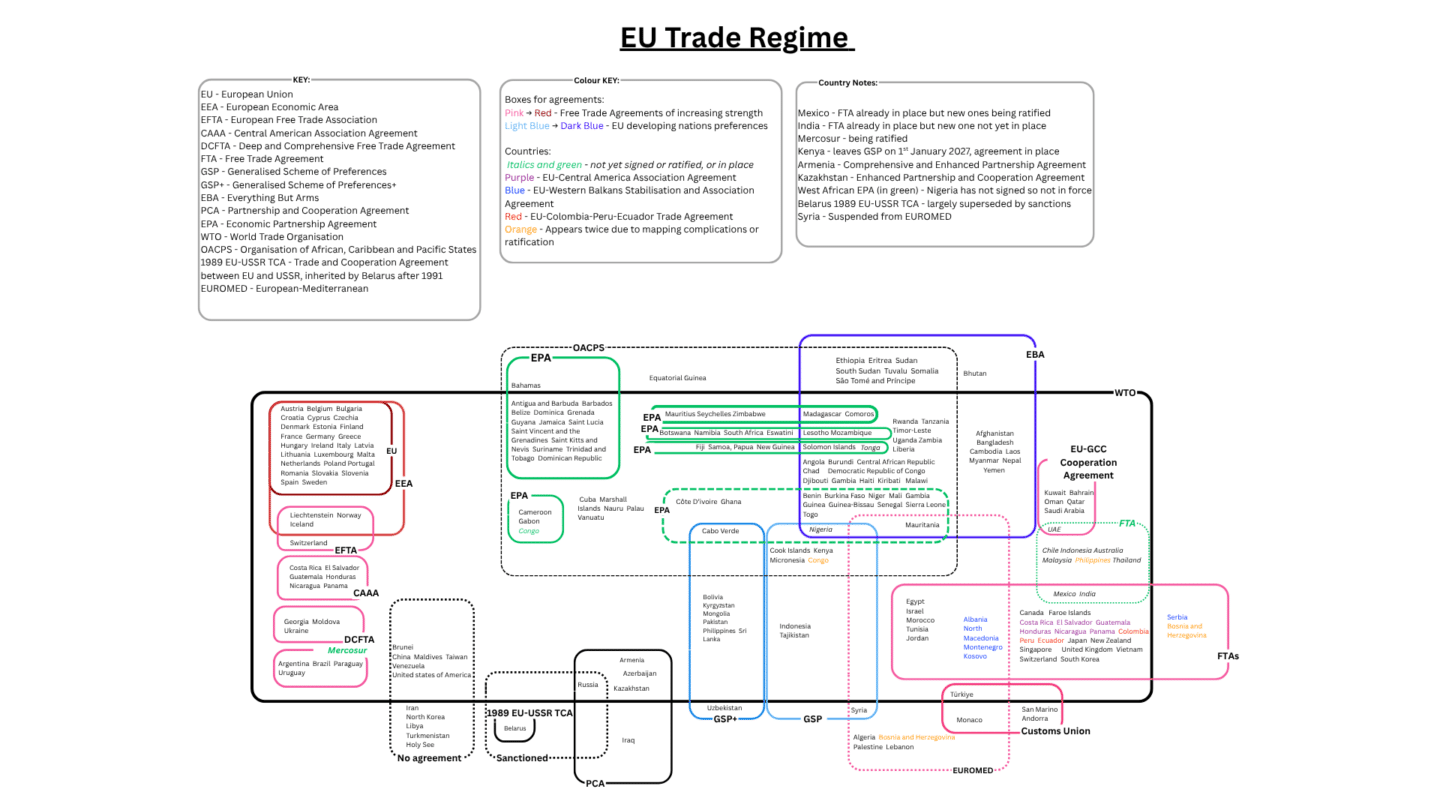
The diagram shows how complicated the EU’s trade relations with the world are, both in terms of different types of agreements (ranging from partnership arrangements to free trade areas and customs unions), and how they overlap with each other.
When creating the EU Trade regime, I first consulted a 2004 depiction of the trade regime, which appeared to be the most recent preceding version, this was very helpful as I was able to see straight away which agreements I needed to look into for any changes, such as the WTO, EUROMED and the GSP system.
On doing some research, some agreements had been dissolved, such as the drug producers (including Peru, Colombia, Venezuela, Bolivia, Ecuador) – Peru, Colombia and Ecuador agreeing to a Free Trade Agreement, Bolivia joining GSP+ and Venezuela currently having no agreement.
The biggest change was the EU’s Generalised System of Preferences - which provides preferential access to certain goods to developing countries where the degree of preferential access depends on which group a developing country belongs to:
- Duty and quota free access to the EU Single Market, except arms
- GSP+ – zero tariffs on products covered by standard GSP, for vulnerable developing countries in return for sustainability and governance commitments
- Standard GSP – reduced or zero tariffs for eligible low- and lower-middle-income developing countries
This gives countries deals based roughly on their situation, rather than a one-size-fits-all approach.
Also, after 2004, the EU developed the Economic Partnership Agreements (EPAs) with different groups of countries from African, Caribbean and Pacific States (ACP). Where the GSP involved the EU giving LDCs preferential access, the idea behind the EPAs was that both sides would give each other improved preferences. The EPAs aimed to grant duty-free, quota-free access for qualifying exports to the EU, along with more flexible rules of origin (allowing inputs from other countries). Improving mobility of trade and greater certainty for the countries involved.
Another change is that the WTO gained 18 members since 2004, most notably Russia and Saudi Arabia. The WTO works on a most favoured nation basis, meaning that any trading advantage (such as favourable tariffs) applied to one member must also be applied to all others. Countries can of course sign their own agreements to give others favourable access, provided those agreements are WTO-compatible.
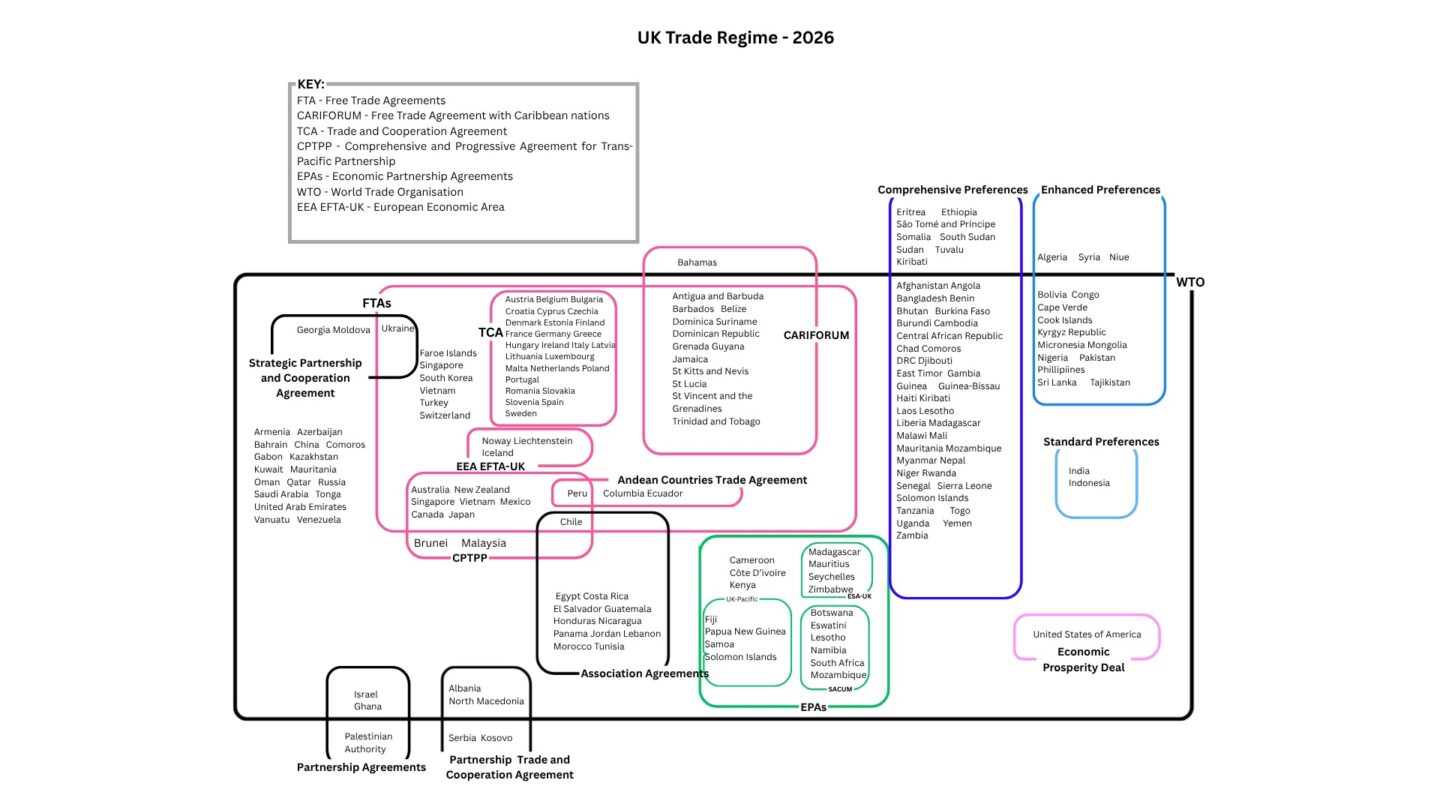
Creating an analogous diagram for the UK proved a far easier process as all the trade agreements are listed on the UK Government website. When the UK was a member of the EU, the UK was subject to the same agreements as the EU. Since Brexit it has transitioned many of these trade agreements and also signed its own new agreements (eg. Australia, New Zealand, India) and joined the Comprehensive and Progressive Agreement for Trans-Pacific Partnership, as well as signing the Trade and Cooperation Agreement with the EU.
A substantial difference is the UK’s equivalent of the GSP system. Still split in three but instead categorised as:
- Comprehensive preferences – for Least Developed Countries (LDCs) as designated by the UN, allowing for 99.8% of product lines tariff free UK entry, the UK’s equivalent to EBA
- Enhanced Preferences – for eligible low-income and lower-middle-income countries that are economically vulnerable, but not LDCs, allowing for 92% of product lines entering the UK tariff-free
- Standard Preferences – for eligible low- and lower-middle income countries that don’t qualify for enhanced preferences, allowing for 65% of products to enter the UK tariff-free, and a further 26% with reduced tariffs. Although the only two countries in Standard Preferences, Indonesia and India, are both leaving, Indonesia in January 2027 after it has been classified as an upper-middle-income country for 3 years in a row. India is also on its way out as it is in a transition period, after signing an FTA with the UK in July 2026, officially leaving in July 2028
How do the trade regimes compare?
The UK’s trade system is comparatively simpler to represent with less overlap and less groups within groups. The EU has many Economic Partnership Agreements with countries within its GSP system, grouped by geographic location, such as West African, Caribbean etc. Whereas the UK’s is comparatively simpler to display, with the countries in the preference tiers only using the preference system, not having the choice of which agreement to use.
With the recent discussions about closer relations between the UK and the EU, and some even actively mooting rejoining the EU, the diagrams are useful for thinking through what rejoining might mean for the UK, in terms of its trade relations with the rest of the world.
Footnotes
- Except for Bosnia and Herzegovina which is complicated due to being in the Euromed, and FTA and not in the WTO.
Author Profile