 Centre for Inclusive Trade Policy home page
Briefing Paper
Devolution and Post-Brexit UK FTAs: The Story So Far
Whitten, C. L and Araujo, M. B. (2026) Devolution and Post-Brexit UK FTAs: The Story So Far, CITP Briefing Paper 33
Published 26 June 2026
CITP Briefing Paper 33
Key points
- The return of trade policy powers to the UK raised concerns about the possible exclusion of devolved administrations from decision-making on trade agreements that could limit their regulatory autonomy.
- The ‘Territorial Inclusivity and Devolution’ research project examined how post-Brexit UK trade agreements affected devolved territories – Scotland, Wales and Northern Ireland – and the extent of their involvement in trade negotiations.
- Researchers used a mixed-methods approach, combining analysis of trade agreements and official documents with interviews of UK and devolved government officials.
- A comprehensive UK International Agreements Database was created, covering over 250 agreements from 2017–2024 and tracking overlaps between treaty provisions and devolved competences.
- Trade agreements were far more likely than non-trade agreements to overlap with ordinarily devolved policy areas (84% versus 47%).
- Implementation of major post-Brexit UK trade agreements, including the Australia and New Zealand FTAs and the CPTPP accession, required only limited legislative changes, at central and devolved level.
- This research shows, however, that devolved regulatory autonomy can be undermined through the interplay between FTAs and the domestic legal framework governing the implementation of such FTAs.
- Regarding devolved involvement in trade negotiations, this research found that devolved administrations were consulted more frequently on trade agreements than on non-trade agreements. Consultation on trade agreements increased significantly after 2019, indicating more regular and constructive intergovernmental cooperation than previously assumed.
The return of trade powers to the UK as a consequence of Brexit, raised questions about the involvement of devolved administrations in a newly independent UK trade policy and its possible impacts in devolved territories. Those questions became the focus of a CITP project – Territorial Inclusivity and Devolution – which set out to explore (i) if and how post-Brexit UK trade agreements affected devolved autonomy and (ii) the extent and manner in which devolved administrations were involved in negotiations on UK trade agreements.
This briefing paper summarises the research project, describes its outcomes and sets out key findings, some of which were unexpected.
Research Context
Decentralisation of powers in the UK through devolution occurred in the context of EU membership. The fact that the EU regulates all aspects of trade on behalf of its Member States meant that potential overlaps and conflicts between trade agreements and devolved competences were not felt as keenly as they might have been if decisions were being made in London rather than in Brussels. EU membership thus created a distance whereby trade policy making at EU level felt removed from the realities of devolved politics. At the same time, the shared obligation on all parts of the UK to implement EU laws had acted as a constraint on the degree of intra-UK regulatory divergence which would otherwise have been possible because of devolution. Furthermore, the parallel expansion of the scope of powers devolved to Scotland, Wales and Northern Ireland and the scope of modern trade agreements into policy areas that are often devolved in the UK, meant post-Brexit UK FTAs were very likely to overlap with devolution.
Against this backdrop, the prospect of powers to negotiate and conclude trade agreements returning to the UK raised concerns about the possible exclusion of devolved administrations from processes very likely to impact on areas of policy for which they had responsibility. Devolved authorities also worried that post-Brexit UK FTAs may be used to regulate areas that ordinarily fall within devolved competence, thereby inhibiting their regulatory autonomy. At the same time, the UK government was concerned that intra-UK divergence at devolved level might undermine its leverage in trade negotiations.
With all these factors in play, the Territorial Inclusivity and Devolution project investigated two categories of issues concerning devolved authorities position in post-Brexit UK trade policy: [1] the impact of post-Brexit UK trade agreements on devolved competence, legislation, and regulatory autonomy [2] the extent and nature of devolved administrations involvement in the negotiation and conclusion of post-Brexit UK trade agreements.
Research Method and Database
The research used a mixed methods approach combining content analysis of official documents on, and legal texts of, post-Brexit UK international agreements with semi-structured interviews with officials from devolved and central governments directly involved or inputting to the negotiation and conclusion of UK trade agreements.
An original UK International Agreements database was developed in which all the international agreements that had been laid before parliament between mid-2017 and end-2024 are recorded.1 To enable comparative analysis of trade vs non-trade agreements, the database includes all relevant international agreements but distinguishes between trade and non-trade agreements. The database brings together data points from a range of different official sources on each of the over 250 international agreements it features and therefore represents a novel record of UK treaties, one that is uniquely comprehensive, particularly from a devolved perspective. It records descriptive details on the treaties (i.e., title, date of signature, date laid in parliament, date of entry into force, command paper reference, subject matter, legislative implementation, and lead UKG department) then provides a high-level (“yes” or “no”) assessment of whether or not provisions in the treaty overlap with areas of devolved competence in one or more devolved territory and notes which policy areas are affected, where overlaps exist. It also describes the nature of consultation carried out by central government with devolved governments as reported by the former.
Because of a reliance on central government reporting, the database alone is insufficient to answer the questions underpinning this research. To further understand the impacts of post-Brexit UK trade agreements, it was necessary to speak to relevant officials, particularly in Scotland, Wales, and Northern Ireland. The findings set out below draw on both the database and the interviews.
Research Findings
[1] UK Trade Agreements and Devolved Competence, Legislation and Regulatory Autonomy
Given the scope of devolved powers in the UK and the potential for contemporary FTAs to impose regulatory disciplines on signatories, it was expected that post-Brexit UK FTAs would overlap with ordinarily devolved policy areas and consequentially constrain devolved regulatory autonomy. In practice, based on this research, the picture is more complex.
While trade agreements were found to be more likely that non-trade agreements to overlap with devolved competence (47% of non-trade agreements and 84% of trade agreements), high levels of overlap did not translate to requiring significant changes in devolved law to implement new post-Brexit agreements.
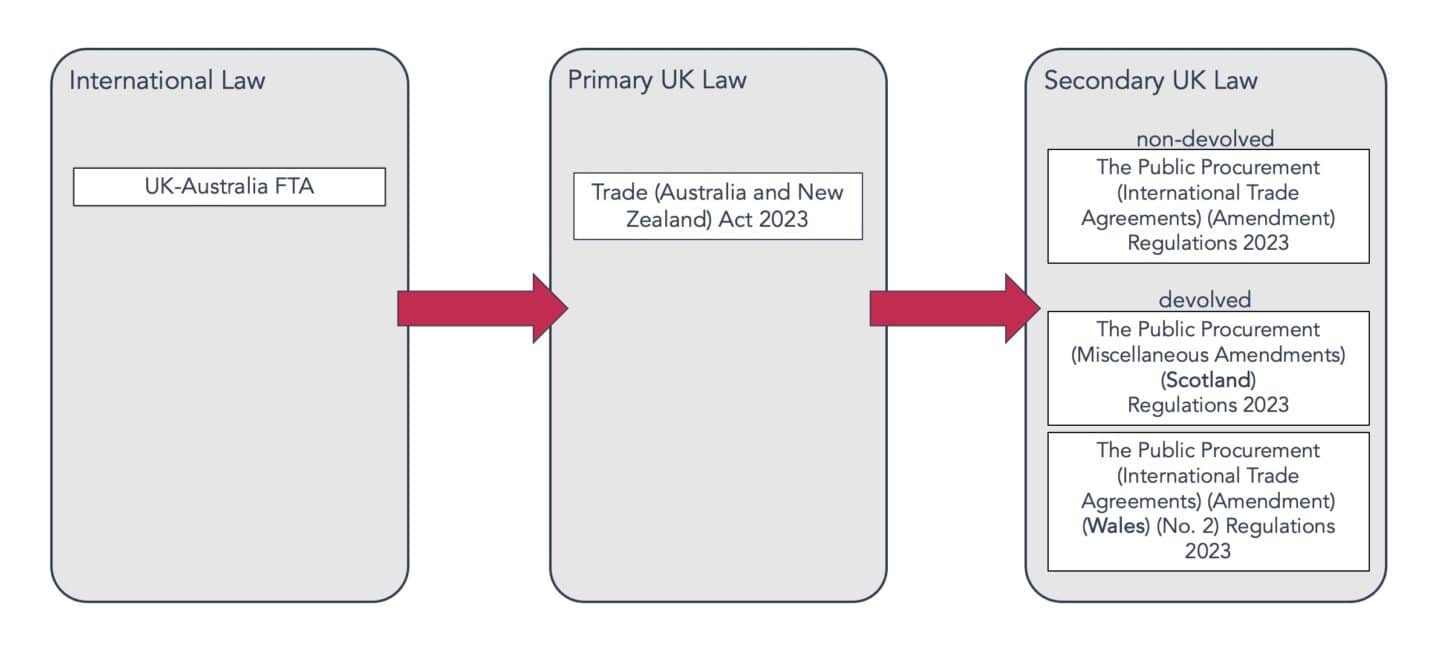
The two primary acts of UK law adopted to give effect to new trade agreements during the research period were remarkably specific in their effects. The free trade agreements (FTAs) that the UK concluded with Australia and New Zealand were given effect domestically by a dedicated act of primary law and the UK’s agreement on Accession to the Comprehensive and Progressive Agreement for Trans-Pacific Partnership was also given effect by a dedicated primary act. Notwithstanding the expansive scope of the UK-New Zealand FTA, the UK-Australia FTA, and the CPTPP respectively, the implementing legislation for all three is narrowly focused. The Australia and New Zealand implementing legislation relates to the government procurement chapters of the FTAs; the CPTPP implementing legislation is more expansive but is still relatively small in scope concerning only: technical barriers to trade, government procurement, and intellectual property. The specificity of this primary legislation is notable insomuch as it indicates that, despite being ‘new’ to the post-Brexit UK, these agreements do not seem to have introduced extensive new regulatory obligations domestically, including at devolved level.
Figure 1: UK Legislative Implementation: CPTPP Accession Protocol
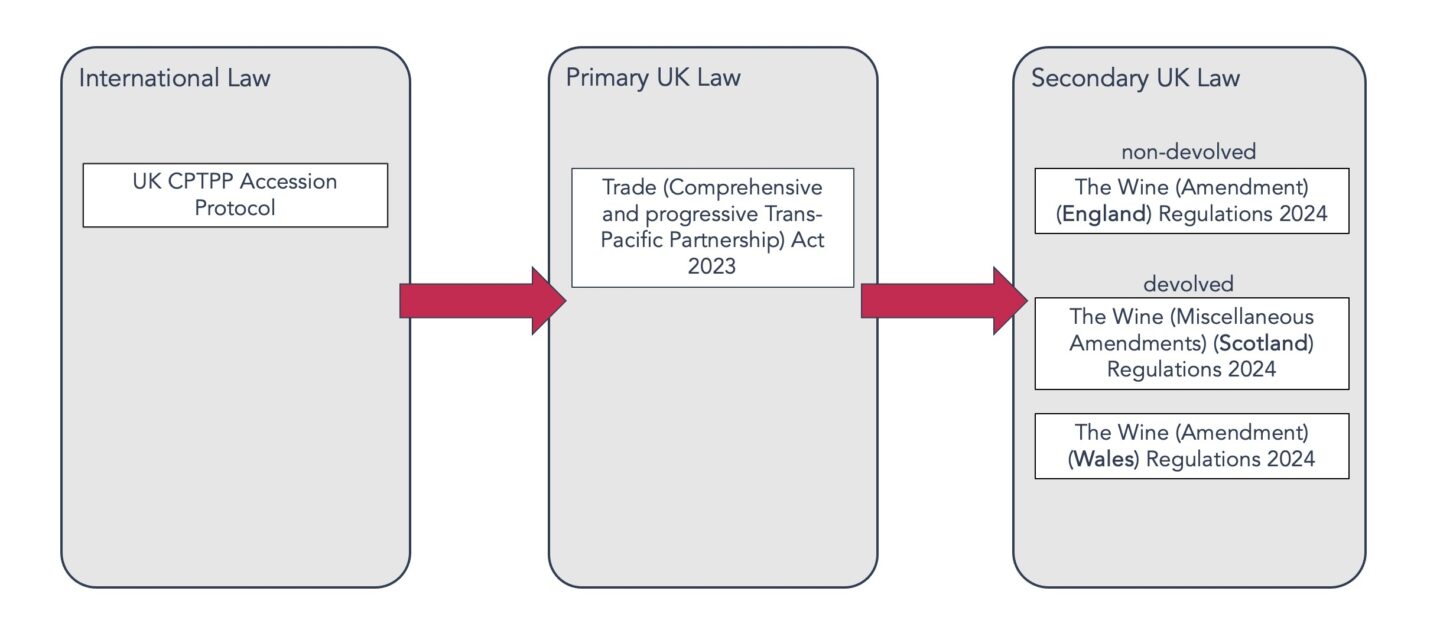
A very small number of legislative changes were made at devolved level to give effect to new post-Brexit FTAs, as indicated in Figures 1 and 2 the only amendments required concerned the marketing of wine products and the regulation of public procurement. This reflects the fact that these agreements tend to focus more on trade liberalisation than market integration, often reflecting and reaffirming the existing domestic regulatory standards.
Figure 2: UK Legislative Implementation: Australia and New Zealand FTAs
All of this suggests that concerns about devolution being ‘hollowed out’ by an independent UK trade policy appear to have been overstated. Similarly, UK government concerns that regulatory divergence at devolved level might undermine its ability to negotiate UK FTAs appears unwarranted. At the same time, however, part of the justification from central UK government for the introduction of domestic constraints on devolved autonomy – such as the United Kingdom Internal Market Act 2020 – was to ensure its ability to negotiate and conclude trade agreements. Therefore, despite the UK FTAs considered here placing limited direct constraints on devolved autonomy, this research highlighted the important impact of their use as a pretext to justify imposing domestic limits on devolved authorities’ pursuit of regulatory divergence.
In this context, another issue of concern for devolved authorities related to the means of implementation of post-Brexit UK FTAs and the potential erosion of competences. If extensive new regulatory obligations were required to be given effect domestically, so called ‘concurrent powers’ can be introduced whereby both central and devolved governments have the authority to regulate the same area. As the paper discusses in more detail, while this research did not find evidence of a significant increase in concurrent powers for the purpose of FTA implementation, it did underline the important role that domestic implementation frameworks can play in the overall impact of FTAs on national and subnational autonomy. It is not enough to simply look at the effect of rules included in FTAs but, to fully appreciate their impact on regulatory autonomy, it is essential to also examine the interaction of those rules with domestic legal frameworks.
Findings from this strand of the research is the focus of an article published in Legal Studies journal which provides more detail on the nuanced conclusions summarised here.2
[2] Extent and Nature of Devolved Involvement in UK Trade Agreements Negotiation and Conclusion
In 2022 the UK revised its architecture for managing intergovernmental relations following a four-year review of the previous system, the conclusions of which set out new operating principles and a new three-tiered structure for UK IGR. Despite such a wholesale revision of IGR architecture, reports on the efficacy of intergovernmental working after the new system took effect continued to be broadly negative. Considering that, in countries such as Canada and the US, the conduct of external trade policy has been a source of political tension between different levels of government, based on international experience, the UK’s nascent external trade policy could be expected to emerge as an additional source of tension in the already strained IGR of the Brexit and post-Brexit era. Based on this research, however, this is not necessarily the case.
Drawing on findings from the content analysis of official documents as well as the interviews with trade policy officials, this research found that devolved administrations were more likely to be consulted on trade agreements than non-trade agreements.
Figure 3: Consultation of Devolved Administrations – Trade Agreements vs Non-Trade Agreements
Higher rates of devolved consultation regarding trade agreements are partly due to the high likelihood of overlap between the provisions of trade agreements and ordinarily devolved competences. There had, however, been a change in frequency of devolved consultation across the research period (between 2018 and 2024) with a sharp uptick in levels of consultation from 2019 to 2020. This is, at least in part, due to parliamentary pressure applied to central government regarding their consultation practices in the first few years of an independent UK trade policy.
Figure 4: Consultation of Devolved Administrations on Trade Agreements – 2018 to 2024
In contrast to earlier assessments regarding the (lack of) engagement between central and devolved governments this research indicated that, in relation to external non-EU trade policy, there is ongoing and regularised intergovernmental consultation, particularly at official level.
Findings from this strand of the research is the focus of an article published in Territory, Politics and Governance journal which provides more detail on the novel insights into the operation of intergovernmental relations and structures regarding external trade summarised here.3
Conclusion
Overall, the ‘Territorial Inclusivity and Devolution’ research project yielded some interesting, unexpected and valuable results. It revealed the potential complexity of the interplay between FTA regulatory obligations and domestic legal frameworks and uncovered a surprisingly positive story regarding intergovernmental relations in the post-Brexit UK. The development of the UK International Agreements database can also serve as a tool for future research.
Footnotes
- Lisa Claire Whitten (2026). UK International Agreements Database, 2017-2024. [Data Collection]. Colchester, Essex: UK Data Service. 10.5255/UKDA-SN-858456
- Lisa Claire Whitten, Billy Alexis Melo Araujo, Viviane Gravey (2026) ‘UK trade agreements and the double bind of devolved regulatory autonomy: the interplay of external commitments and domestic constraints’ Legal Studies pp.1 – 21
- Lisa Claire Whitten, Billy Melo Araujo, Viviane Gravey (2026) ‘A Brexit Benefit? Exploring devolved government’s involvement in UK trade policy’ Territory, Politics, Governance pp. 1 – 17.
Author Profiles

Lisa Claire Whitten